Overhead Crane Anti-Collision System: Intelligent Collision Warning for Industrial Cranes

Overhead cranes are the workhorses of modern industry. From construction sites and steel mills to shipyards and automotive plants, these powerful machines lift, move, and position loads that can weigh dozens of tons. They are essential to productivity — but they are also among the most dangerous equipment in any industrial facility. Preventing crane collisions requires more than vigilance; it requires intelligent technology that sees what operators cannot.
The numbers tell a stark story. According to the U.S. Bureau of Labor Statistics (BLS), crane-related incidents cause an average of 44 fatalities and more than 8,000 disabling injuries annually in the United States. Approximately 45% of crane accidents involve contact with power lines or electrical sources, while collisions between crane components and facility structures, equipment, or personnel account for a significant portion of remaining incidents.
The risk factors extend beyond equipment failure. According to the Crane Inspection & Certification Bureau (CICB), approximately 90% of crane accidents are caused by human error — including miscommunication, inadequate training, and failure to follow proper safety protocols. Each accident carries devastating human cost, alongside operational disruptions, regulatory penalties, and financial liability that can cripple operations for weeks or months.
The challenge is compounded by the nature of crane operations themselves. Operators work from limited vantage points, often unable to see the full path of the load or hook. Blind spots are inherent to the equipment. Spatial awareness becomes guesswork when moving multi-ton loads through complex facilities with narrow clearances, overhead obstructions, and active work zones.
Traditional safety methods — human spotters, painted floor markings, manual measurements — provide some protection, but they depend entirely on human vigilance in environments where distractions, fatigue, and communication failures are ever-present risks. These approaches cannot continuously monitor three-dimensional space or predict collision trajectories in real time. That is why modern crane anti-collision systems have become essential for any facility operating overhead cranes.
How Does Wipelot's Crane Anti-Collision System Prevent Overhead Crane Accidents?
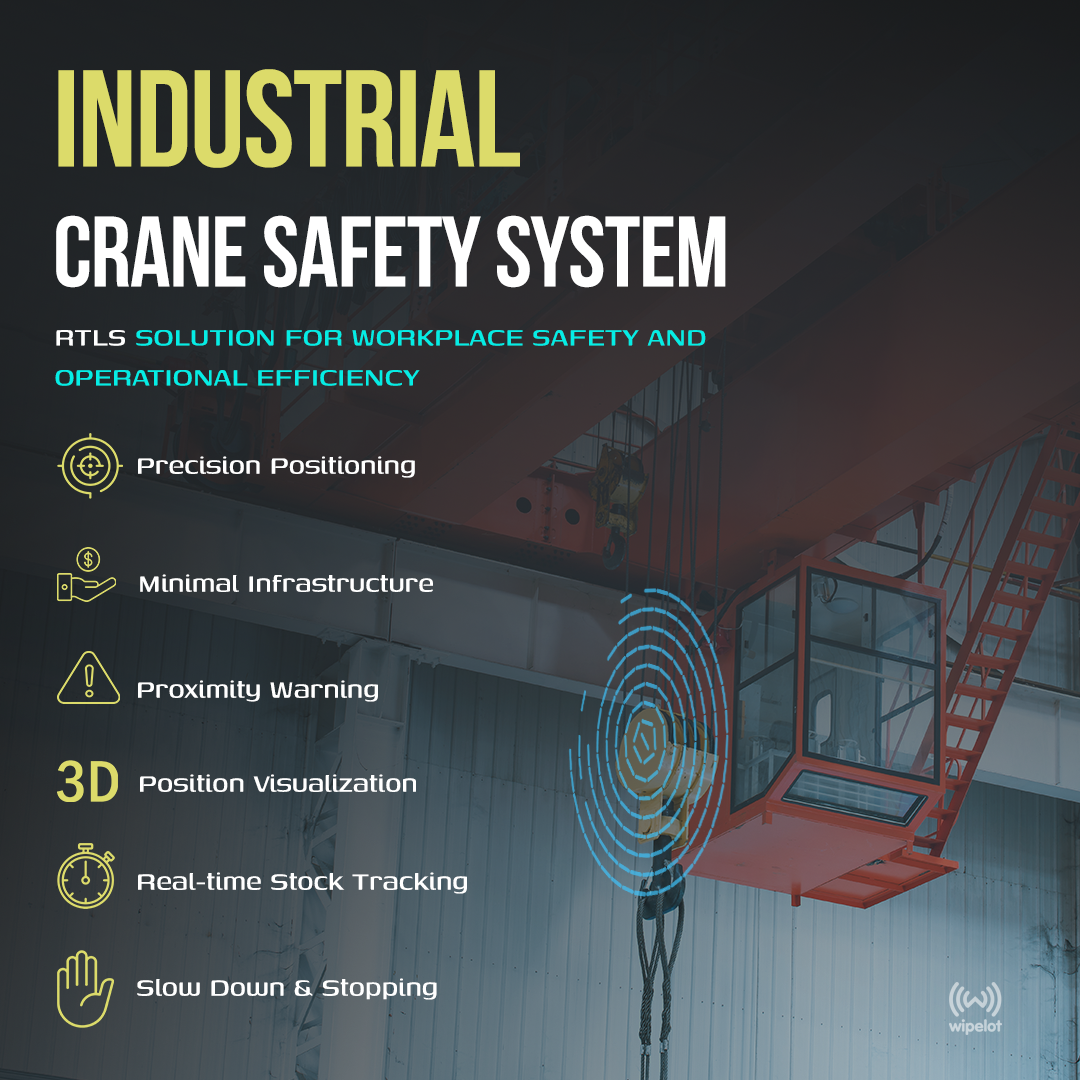
Wipelot has engineered an intelligent overhead crane anti-collision system that eliminates uncertainty from crane operations. Powered by RTLS (Real-Time Location System) technology and real-time 3D spatial mapping, the system creates a protective digital envelope around moving cranes, loads, and facility infrastructure — detecting potential collisions before they occur and alerting operators with time to respond.
Through precision sensors mounted on crane structures and integrated with facility mapping software, Wipelot's crane collision avoidance system continuously monitors the position of crane hooks, loads, trolleys, and bridges in three-dimensional space with up to 20 cm (approximately 8 inches) positioning accuracy. The technology calculates collision trajectories in real time, accounting for load swing, crane movement speed, and proximity to walls, columns, equipment, and other cranes operating in shared airspace.
When the system detects a potential collision, it responds instantly. Visual alerts appear on operator displays, showing exactly where the hazard exists. Auditory warnings escalate as proximity decreases, ensuring operators cannot miss critical notifications. Automated slow-down protocols can also engage, reducing crane speed in high-risk zones to give operators additional reaction time.
Crane Anti-Collision Technologies Compared: RTLS vs. Laser, Lidar, and Radar
Several technologies are available for overhead crane collision avoidance, each with distinct capabilities and limitations. Understanding these differences is critical for selecting the right crane anti-collision system for your facility.
Laser and infrared crane anti-collision sensors measure point-to-point distances along a single axis — typically detecting bridge-to-bridge or bridge-to-wall proximity. They are cost-effective for simple two-crane runway configurations, but they cannot track hook position, load swing, or vertical clearance. Their protection is limited to the specific axis where the sensor is mounted.
Lidar-based crane collision avoidance systems offer broader spatial awareness with 2D scanning capabilities and higher resolution. However, lidar performance can degrade in dusty, smoky, or humid environments — conditions common in steel mills, foundries, and heavy manufacturing. Lidar also measures distance from a fixed vantage point rather than tracking the absolute position of moving components.
Wipelot's RTLS-powered crane anti-collision system provides continuous 3D position tracking of every crane component — hooks, trolleys, bridges, and swinging loads — across the entire facility. Rather than measuring static distances, the system calculates dynamic movement vectors and predicts collision risk based on converging trajectories. This enables protection against crane-to-crane, crane-to-structure, and crane-to-personnel conflicts simultaneously, including scenarios where loads swing unpredictably or multiple cranes converge in shared airspace.
For facilities with complex layouts, multiple overhead cranes, or environments that challenge optical sensors, RTLS-based crane collision avoidance delivers the most comprehensive protection available.
What Results Does Crane Collision Avoidance Deliver in Heavy Industry?
Steel mills, shipyards, automotive manufacturing plants, and construction sites have deployed Wipelot's crane collision warning technology with transformative results. The system prevents crane-to-wall and crane-to-structure collisions that cause costly damage and dangerous situations. It eliminates crane-to-crane conflicts in facilities where multiple overhead systems share operational space. It protects personnel working beneath or near crane paths by alerting operators to ground-level activity. And it reduces load swing incidents by providing real-time feedback on pendulum motion and clearance margins.
Why Choose Wipelot's Crane Anti-Collision System Over Traditional Safety Methods?
- Three-dimensional awareness – Complete crane collision monitoring covers every axis of movement, from hook height to bridge position and trolley travel, with up to 20 cm accuracy.
- Intelligent prediction – Advanced algorithms calculate collision risk based on movement vectors, load dynamics, and facility geometry — not just static proximity measurements used by conventional crane anti-collision sensors.
- Multi-crane coordination – In facilities with multiple overhead cranes, the system manages shared airspace simultaneously, preventing crane-to-crane conflicts before they develop.
- Operator-focused design – Intuitive alerts and displays provide actionable information without overwhelming operators or disrupting workflow.
- Retrofit-ready installation – Compatible with existing crane systems across manufacturers and facility types, enabling rapid deployment without equipment replacement or major infrastructure modifications.
- Environmental resilience – Unlike optical sensors that can be affected by dust, smoke, or humidity, RTLS-based crane anti-collision technology maintains reliable performance in harsh industrial conditions.
From Reactive Safety to Proactive Crane Collision Prevention
In industries where overhead cranes are indispensable, safety cannot be left to chance or human vigilance alone. With Wipelot's crane anti-collision system, industrial facilities gain more than a warning system — they gain an intelligent safety layer that continuously monitors three-dimensional space, calculates converging trajectories, and transforms high-risk crane operations into controlled, predictable processes where safety and productivity work in harmony.
As crane-related incidents continue to account for significant fatalities and injuries across heavy industry, the shift from reactive safety measures to proactive, technology-driven collision prevention is no longer optional. Wipelot's overhead crane collision avoidance system delivers the precision, intelligence, and reliability that modern industrial operations demand.
FAQ: Overhead Crane Anti-Collision & Collision Avoidance Systems
- Q: What is an overhead crane anti-collision system?
- A: An overhead crane anti-collision system is a safety technology that monitors crane positions in real time and prevents collisions between cranes, structures, and personnel. Wipelot's system uses RTLS (Real-Time Location System) technology with 3D spatial mapping and precision sensors to create a protective digital envelope around cranes and their loads, delivering up to 20 cm positioning accuracy.
- Q: How does Wipelot's crane collision avoidance system prevent accidents?
- A: The system continuously monitors crane component positions — including hooks, trolleys, bridges, and loads — and calculates real-time collision trajectories, considering variables like load swing, movement speed, and proximity to obstacles. It instantly triggers visual and auditory warnings, and can initiate automated slow-down protocols in high-risk zones.
- Q: What makes Wipelot's crane safety system different from traditional collision avoidance?
- A: Traditional systems use laser or infrared sensors that measure distance along a single axis. Wipelot's system provides continuous 3D position tracking of every crane component using RTLS technology, enabling predictive collision risk calculation based on dynamic movement vectors — not just static proximity. This eliminates blind spots and enables multi-crane coordination in shared airspace.
- Q: Can a crane anti-collision system be installed on existing cranes?
- A: Yes. Wipelot's crane anti-collision technology is designed to be retrofit-ready and compatible with existing crane systems across various manufacturers and facility types, ensuring rapid deployment without requiring new equipment or major infrastructure modifications.
- Q: What are the primary benefits of crane collision warning systems?
- A: The main benefits are eliminating crane-to-structure and crane-to-crane collisions, safeguarding ground-level personnel, and reducing equipment damage and operational downtime by up to 30% by creating controlled, predictable lifting processes.
- Q: What positioning accuracy does Wipelot's crane anti-collision system achieve?
- A: Wipelot's RTLS-based crane anti-collision system achieves up to 20 cm (approximately 8 inches) positioning accuracy for crane hooks, trolleys, and bridges. This sub-meter precision enables reliable collision prediction even in facilities with tight clearances and complex layouts.
- Q: How does RTLS-based collision avoidance compare to laser or lidar systems?
- A: Laser and lidar systems measure point-to-point distances along a single axis, typically detecting only bridge-to-bridge or bridge-to-wall proximity. RTLS-based collision avoidance provides continuous 3D position tracking of every crane component — including hooks and swinging loads — enabling predictive collision risk calculation based on movement vectors, not just static distance measurements.
- Q: Can a crane anti-collision system handle multiple cranes in shared airspace?
- A: Yes. Multi-crane coordination is a core capability of Wipelot's system. It simultaneously tracks all cranes operating in shared airspace, calculates converging trajectories, and prevents crane-to-crane conflicts before they develop — a scenario where traditional single-point sensors cannot provide adequate protection.
- Q: What industries need overhead crane collision avoidance systems?
- A: Steel mills, shipyards, automotive manufacturing plants, warehousing and logistics centers, and construction sites benefit most from overhead crane collision avoidance systems. Any facility operating overhead cranes — particularly those with multiple cranes, tight clearances, or active ground-level work zones — can significantly improve safety and reduce downtime with this technology.
- Q: How long does it take to deploy a crane anti-collision system?
- A: Deployment timelines vary based on facility size and number of cranes, but Wipelot's system is designed for rapid installation with minimal infrastructure requirements. The retrofit-ready architecture means no structural modifications are needed, and the system can typically be operational within days rather than weeks.
Ready to eliminate crane collision risks in your facility? Contact Wipelot to schedule a consultation, or discover how Wipelot's safety solutions can protect your operations and workforce.